
Introduction
Pakistan, after independence in 1947, joined the US-led Western bloc and collective defence partnerships such as the South-East Asian Treaty Organization (SEATO) and the Central Treaty Organization (CENTO). As a part of the American containment strategy in South Asia, it subsequently received billions in economic, military and developmental assistance from the US and the World Bank and the International Monetary Fund, along with multiple bailouts. US-Pakistan military cooperation rose exponentially, such as multiple defence exports or providing airbases for launching U-2 surveillance flights against the Soviet Union. US-Pakistan cooperation rose exponentially post-1979, following the anti-US Islamic Revolution in Iran, and the Soviet invasion of Afghanistan. Since then, Pakistan became an important strategic outpost for its observations and interventions in West Asia, and a crucial logistical base for the US to counter Soviet forces, using ‘mujahid’ tribal fighters launched from Pakistan to fight a guerilla war against Soviet regulars, who, following Soviet withdrawal in 1989, regrouped to form the Taliban. (Rubin, 2002; Dawn, 2012; Hussain, 2016; Javaid & Mushtaq, 2025)
Historically, US-Pakistan relations have been checkered, with religious extremism, terrorism, and a praetorian political system jeopardizing US support. However, containment pursuits led to deliberate oversight, with the regimes of military dictators being legitimised, human rights violations being condoned, and the destabilization of Jammu and Kashmir and Pakistan-Occupied Jammu Kashmir being slighted at its behest. Pakistan’s religious solidarity with the Arab-Muslim world, and staunch criticism of Israel, a steadfast ally of the US, was also sidelined for geopolitical pursuits. Therefore, while Pakistan facilitated the Sino-US rapprochement under President Nixon, it was not so cordial during Raegan’s tenure- until 1979. This relationship may be characterised as one based on strategic interests and realism, rather than a deep bilateral synergy and belief in common global values and a rules-based order.
Pakistan’s geographical and political features
Pakistan is situated between the geographical subregions of South and West Asia, bordering three countries- India to the east, and Afghanistan and Iran to the west. It shares a 2,430 km land boundary with Afghanistan and a 909-km long boundary with Iran. Additionally, it has a 1,046 km long coastline to the Arabian sea, with ports such as Karachi and Gwadar. Dominated by the Punjabi and Sindhi ethno-linguistic groups, it constitutes two of the four administrative regions- Punjab and Sindh. The other two, namely Balochistan and FATA (Federally Administered Tribal Areas) are constituted of predominantly Baloch and Pashto tribal societies, sharing ethnic contiguity with Iran and Afghanistan, respectively. The latter two regions also share the same dry, arid terrain with low rainfall and therefore a nomadic tribe and clan-centric lifestyle is pursued by the communities in sparsely-populated terrain. (Dawn, 2009; Burki & Ziring, 2019)
The above factors have contributed to a heavy political imbalance between the eastern and western parts, due to most military and political ranks rising from the east. This has led to rising separatist tendencies in Balochistan and FATA. Compounded by mineral exploitation, administrative neglect, military high-handedness, and “ethnic superiority” of the Punjabi Muslims has led to constant political movements and armed resistance since Pakistan’s creation in 1947 (Deodhar, 2025). Therefore, the Western regions have heavy military presence in close proximity to both Iran and Afghanistan, states Pakistan alleges to stir up turmoil in its borders. The importance of these facilities shall be studied in the subsequent parts
US-Pakistan cooperation post-2001
Following the devastating September attacks in the US, and the subsequent launch of the US-led ‘Global War on Terror’, allied forces launched a massive attack against Taliban-held Afghanistan in order to eliminate the attacks’ mastermind, Al Qaeda’s Osama bin Laden, and to oust the Taliban in favour of a democratic government. However, it was an uphill battle for a non-regional military force to fight against a guerilla army entrenched in Afghanistan’s inhospitable mountain terrain.
Therefore, the US required a strong regional ally, which would act as a launching pad for the initial invasion, and a logistical partner to supply the offensive. This led to the return of the US-Pakistan strategic partnership, enduring beyond the US’s hasty withdrawal from Afghanistan in 2021
Between 1947 and 2024, the US has granted Pakistan over $144 billion (adjusted for inflation), the details of which have been represented in the table below
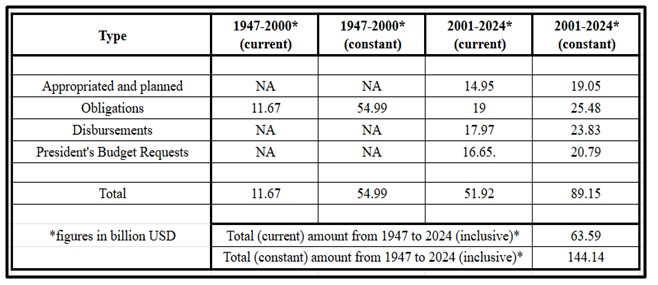
Images 1 and 2: US financial assistance to Pakistan from 1947 to 2024, accounting for original values and value adjusted for inflation.
Source: (Department of State, 2025. Data compiled by author.)
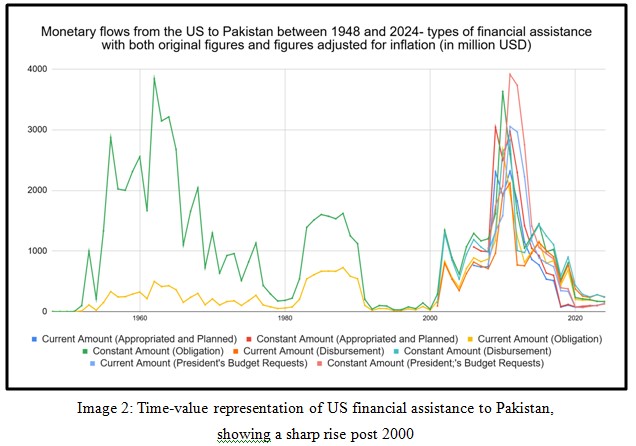
While regular financial aid has been disbursed to Pakistan, there is a sharp uptick of funds after 2001 as represented above, pouring into Pakistan after 2001, suggesting that the USA intended to consolidate the US-Pakistan relationship to sustain its campaign in Afghanistan
Despite reservations of the diversion of funds to terrorist activities and the discovery of bin Laden next to an army garrison in central Pakistan, the relation has been one of the most robust ties in the 21st century. China’s pursuit of the Belt and Road Initiative, the $63 billion China-Pakistan Economic Corridor (CPEC) and the massive Pakistani imports of Chinese weaponry has challenged the US’ hegemony as the dominant external actor in Pakistani politics and economy. It is, however, interesting to note, that while Pakistan’s strategic relationship with China has long surpassed that with the US, the US is doubling down on Pakistani partnership to avoid losing a concrete ally in the region. Therefore, while the Chinese relationship is strategic, the US alliance is purely a tactical maneuver to secure short-term interests (Sharma, 2025).
Pakistan remains one of the closest military allies of the US in the Western Indian Ocean Region (IOR), recently leading anti-piracy and ship-lane defence operations under the multinational Combined Maritime Force 151, running anti-piracy and ship-lane defence operations since the Houthi attacks on shipping in the Red Sea (CMF, 2025). Additionally, as tensions with Iran and West Asia rise and China becomes increasingly ambitious in the IOR, the US seeks to insure its force projection in the region by attaching a potent land, maritime, air and nuclear power in a volatile South Asian region to its long list of US allies in the region. Pakistan’s unique position- which land access to Central and West Asia, and , East Asia (through Pakistan-occupied Jammu Kashmir and the Shaksgam Corridor) alongside a long coastline to patrol the Western Arabian Sea and the Strait of Hormuz, makes it as important a relation as a US ally in the 21st century, as it was in the post-WW2 containment era of Cold War ideo-military confrontation.
Rimland Theory: facets and relevance
Halford Mackinder in his 1919 book ‘Democratic Ideals and Reality: A Study in the Politics of Reconstruction’ propounds the heartland theory- a predominantly interior, Central Eurasian territory surrounded from all sides by mountain ranges, river basins and northern ice floes. This region was surrounded by the coastal regions of Eurasia and Africa (termed the inner crescent), beyond which came the insular seas (Mackinder, 1904; 1919/1942). Nicholas Spykman expanded upon his works in the ‘The Geography of the Peace’, propounding the rimland theory- the geographical buffer with equal access to the heartland and the surrounding insular seas, therefore heaving a blend of land and sea power. This region, which Mackinder describes as the ‘inner crescent’, is of paramount importance to any power that seeks to control the heartland by denying it access to the sea- a vital aspect of boosting comprehensive national power.
The heartland is forced to assume an autarkic economic model. To gain more economic and territorial power, it must gain access to warm water ports, maritime trade routes and by extension, an offensive naval capability- by conquering the nations between itself and the sea. Conversely, should a regional or external actor seek to limit the expansion of the heartland, maritime states of the rimland are the first line of defence to check the otherwise-self-sufficient heartland (Spykman, 1944/1969). While this theory was propounded to check the expansion of the USSR (located within the Central Eurasian heartland as designated by Mackinder) and Communist ideology into the rimland states during the Cold War, it is equally applicable to any maritime or rimland power controlling or intending to control any proximate continental state which lacks it.
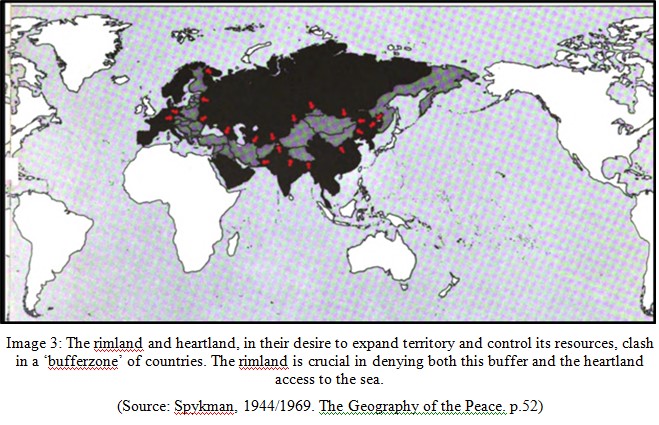
In the 21st century, the growth of sea power ensures that rimland states both encourage and deter economic growth and power by regulating sea access to their continental neighbours. Therefore, rimland states are all the more important to launch attacks on continental states in order to control belligerent entities. As such states lack access to open oceans, they are strictly dependent on land routes for trade, supplies and survival, which may be blockaded for strategic gains. Afghanistan also shares boundaries with Central Asian states- Turkmenistan, Uzbekistan and Tajikistan- which although Muslim states, do not share the extremist tendencies of the Taliban. However, they chose to stay out of providing logistical support to the US to avoid becoming dependents or opening a fresh conflict with the Taliban and its transborder networks. An US-Iran alliance was challenged by decades of hostilities and sanctions, while the US lacked the military alliance, and a long, contiguous border as required with India. Therefore, Pakistan remained the only possible- and the most probable- state from which to launch its offensive against the Taliban.
Analysis
Pakistan remained the largest logistical partner to the US war effort in Afghanistan (Council on Foreign Relations, 2021). The initial days of the Kandahar and Tora Bora campaigns were marked by intense combat for the US to gain a foothold in the rugged Afghan terrain. At this juncture, former US Secretary of State Richard Armitage demanded complete permission for overflight and landing operations, apart from on-demand territorial access for troops and logistics. (Chandio & Khuhro, 2019). Following Pakistan’s acceptance, (verifiable) US military bases emerged in the following locations.
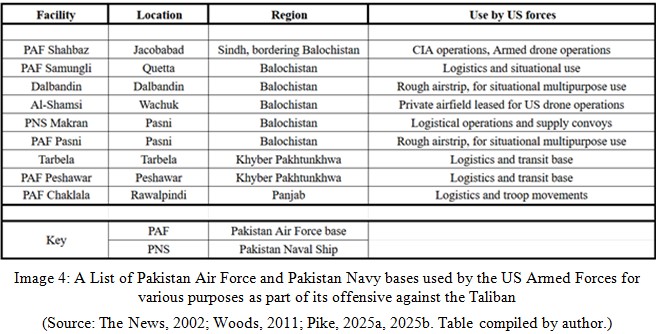
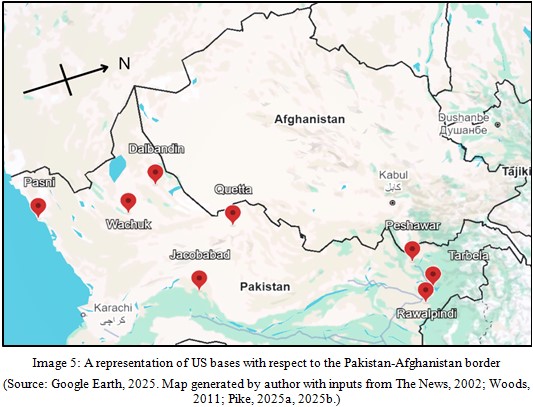
It is evident from the above image how all operational bases have been established in close proximity to the Afghanistan-Pakistan border, with logistical assistance from central and Eastern Pakistan, This helps validate Spykman’s World-War 2 ers theory in the 21st century fraught with varied non-state actors and national military capabilities. The advantage of Pakistan’s naval frontier, as part of the Asian rimland, benefits the US, a naval power without match, to ensure a steady supply of men and material to Afghanistan without violating Afghanistan's or other states’ national airspaces. As Spykman writes,
It is evident from the above image how all operational bases have been established in close proximity to the Afghanistan-Pakistan border, with logistical assistance from central and Eastern Pakistan, This helps validate Spykman’s World-War 2 ers theory in the 21st century fraught with varied non-state actors and national military capabilities. The advantage of Pakistan’s naval frontier, as part of the Asian rimland, benefits the US, a naval power without match, to ensure a steady supply of men and material to Afghanistan without violating Afghanistan's or other states’ national airspaces. As Spykman writes,
“The location of a state may be described from the point of view of world-location, that is, with reference to the land masses and oceans of the world as a whole, or from the point of view of regional location, that is, with reference to the territory of other states and immediate surroundings.” (Spykman, 1938. p. 40)
Therefore, it was Pakistan’s regional location in close proximity to Afghanistan, and its world-location as a maritime state of the rimland, that facilitated close US-Pakistan coordination in the 21st century. On the other hand, a Pakistani military leadership which dominated decision-making ensured strong returns for itself- from misappropriated financial inflows, becoming the fulcrum of a relationship which was forced by military necessities. Therefore, Pakistan’s ‘strategic decision’ to join hands with the US was matched by the US’ own interests in Pakistan’s geographic advantage and its own interests and objectives in Afghanistan.
The Red Sea and the Western IOR is one of the hotspots for global piracy, arms and narcotics smuggling, and is also the site of several attacks against commercial shiplanes due to the value of goods travelling through the Suez Canal. A 2022 dossier highlights a range of pressing issues- from a belligerent Iran, a volatile Iraq and Syria, violent non-state actors such as ISIS, al-Qaeda and the Houthis, as well as the strategic threat of a growing Chinese presence in the IOR- all of which compound to pose a direct, allied or indirect threat to US interests in the region as well as its broader economic and foreign policy goals in Asia and the Indo-Pacific. (US Senate, 2022). Therefore, for a global power like the US, a defensive naval presence is essential in such chokepoints of global trade. To that end, Bahrain hosts the US Central Command (CENTCOM) and the US Fifth Fleet Carrier Strike Group (US NHHC, 2025). It also works with partner navies in the region to secure the region by means of joint patrols. In such scenarios of uncertainty that the US-Pakistan relationship has evolved into a robust security cooperation. Pakistan has since become a key regional contributor to the Combined Maritime Force- a 47-nation partnership involved in patrolling operations in West Asia, with 5 combined task forces.
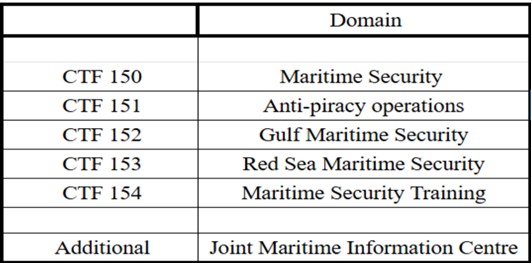
Image 6: Constituent task forces of the Combined Maritime Force Source: (CMF, 2024. Table compiled by author)
Such permeation into every aspect of West Asian maritime security makes Pakistan a credible deterrent against both Iran, considered the US’ only long-term adversary in the region, and violent terrorist entities, with Pakistan interdicting huge quantities of arms and narcotics on the high seas in collaboration with the US. Therefore, Pakistan’s decision to depend on the US has deepened regional cooperation, as a possible stepping stone between military purchases and joint training exercises, and naval berthing agreements and direct or indirect assistance in times of war. Therefore, it can be theorized that current US-Pakistan cooperation in the naval domain is a shoring-up of allies and military powers in West Asia, should a pan-region or a US-China conflict erupt. Additionally, a deep relationship would also help reduce the comprehensive Sino-Pakistan cooperation in the IOR, a policy of appeasement to deny the Chinese access to the Indian Ocean and to reduce the efficacy of its ‘String of Pearls’ initiative. This ensures some degree of US control over the Central Asian and Chinese interiors, which find their own sea access through Iran and Pakistan.
Examining the permanence of the relationship
The US-Pakistan relationship in the 21st century continues to weather the peaks and troughs of terrorism, coups, ideological divergences and foundational distrust as well as during the Cold War period. Despite the bin Laden debacle, aid cuts during the first Trump administration, the US-Indian strategic partnership, rising Chinese prominence in Pakistan and a shift in American focus to European and Indo-Pacific theatres, both nations synchronize in a multitude of economic and security issues, bypassing socio-political clashes. Pakistan’s propensity to run with the hare and hunt with the hound has allowed it to maintain a largely flexible foreign policy by balancing competing American and Chinese interests of accommodating tactical American demands while seeking long-term strategic benefits from its ‘iron brother’ China.
This leads us to ask the question, if it was the US which cultivated Pakistan as a dependent ally or vice versa. Mahan’s sea power theory requires nations to establish secure bases in locations wherein a maritime power seeks to establish commercial and military supremacy (Mahan, 1890, pp. 82–83). On the other hand, Spykman’s rimland theory suggested that the rimland nation holds the power to influence the heartland, and therefore the external power is dependent upon its support to control the interior. Stephen Walt, writing on the process of alliance formation, uses Nixon’s Israel policy to suggest that providing assistance to a dependent state empowers it, sometimes making it too strong to require the support of the benefactor (Walt, 1985. pp. 29-30). Therefore, it may not be outlandish to suggest it is the latter proposition which may hold true.
There is an evident inequality between the military and economic prowess and global influence of the US and Pakistan. However, Spykman, his predecessors and his successors all hold true the first dictum of geopolitics- that geography dictates foreign policy and strategy. Therefore, we may analyse this relationship as Pakistan not supporting the US invasion of Afghanistan, but being the fulcrum and facilitator of US foreign policy in South Asia. This might hold the realist explanation to US support to dictatorial regimes, humanitarian abuses, religious separatism and terrorism and at times support to terror outfits fighting US and coalition forces in Afghanistan and the Western IOR- it was but a small sacrifice to ensure US military presence in the region, and therefore to fulfill the core interest of US foreign policy to maintain a credible presence through a network of dependable allied states occupying the rimland of South Asia and the Persian Gulf.
Conclusion
US-Pakistan cooperation is an evident convergence of mutually beneficial interests pushed together by Pakistan’s optimal geography, which Pakistan was strategic enough to market as its universal selling point, and the US was pragmatic enough to utilise to its advantage. This helps justify the relationship, for it is antithetical to the US’ proclaimed global pursuits of liberal democracy and peace and stability to engage so comprehensively with a nation rocked by political instability, religious extremism, an overbearing military and a justified commitment to supporting terror and subversive networks in other countries. US-Pakistan relations in the 21st century, as in the period before, stand in testimony to Spykman’s predictions, that the rimland is the first defence against the expansion of the heartland, but the first line of offence for the conquest of the heartland. Therefore, the nation which controls the heartland controls both the heartlandic states that seek expansion, and the extra-regional allies which intend to establish a foothold.
References:
Burki, S. J., & Ziring, L. (2019). Pakistan. In Encyclopædia Britannica. https://www.britannica.com/place/Pakistan
Chandio, L. A., & Khuhro, A. A. (2019). The US-Pakistan relationship in South Asia, 2001-2012: A case study of Afghanistan. Journal of Economics and Political Economy, 6(4), 383–391. https://doi.org/10.1453/jepe.v6i4.1993
CMF. (2024, May 5). Combined Task Forces. Combined Maritime Forces. https://combinedmaritimeforces.com/combined-task-forces/
CMF. (2025, January 22). Pakistan Assumes Command of Combined Maritime Forces’ Combined Task Force 151. Combined Maritime Forces. https://combinedmaritimeforces.com/2025/01/22/pakistan-assumes-command-of-combined-maritime-forces-combined-task-force-151/
Council on Foreign Relations. (2021). A Timeline of the U.S. War in Afghanistan. Council on Foreign Relations; Council on Foreign Relations. https://www.cfr.org/timeline/us-war-afghanistan
Dawn. (2009, October 17). Geography: The borders of Pakistan. The Dawn. https://www.dawn.com/news/884966/geographytheborders-of-pakistan
Dawn. (2012, July 4). Timeline: History of US-Pakistan relations. The Dawn. https://www.dawn.com/news/731670/timelinehistory-of-us-pakistan-relations
Deodhar, Y. (2025). India, Pakistan and the Balochistan Conundrum. Finsindia.org. https://finsindia.org/India-pakistan-and-the-balochistan-conundrum-yashodhan-deodhar.html
Department of State. (2025). U.S. Foreign Assistance By Country: Pakistan. Foreignassistance.gov; US Department of State. https://foreignassistance.gov/cd/pakistan/2002/disbursements/0
Google Earth. (2025). Location of Pakistan’s bases wit relation to the Pakistan-Afghanistan border. Google.com. https://earth.google.com/web/search/Chaklala+Cantt.
Hussain, M. (2016). Pak-US Relations: An Historical Overview. Pakistan Journal of History and Culture, XXXVII(2), 61–76. https://www.nihcr.edu.pk/Latest_English_Journal/Jul-Dec%202016%20No.2/5.%20Pak-US%20Relations%20a%20%20Historical%20Review,%20Munawar%20Hussain%20footnotes%20corrected.pdf
Javaid, U., & Mushtaq, I. (2025). View of Historical Perspective of Pakistan USA Relations; Lessons for Pakistan. South Asian Studies, 29(1), 291–304. https://sasj.pu.edu.pk/9/article/view/795/794
Mackinder, H. (1904). The Geographical Pivot of History. The Geographical Journal, 23(4), 421–437. https://doi.org/10.2307/1775498
Mackinder, H. J. (1942). Democratic Ideals and Reality: A Study in the Politics of Reconstruction. Holt. https://www.files.ethz.ch/isn/139619/1942_democratic_ideals_reality.pdf (Original work published 1919)
Mahan, A. T. (1890). The Influence of Sea Power Upon History, 1660-1783 (pp. 82–83). Little, Brown and Company .
Pike, J. (2025a). Pakistan - Naval Bases. Globalsecurity.org. https://www.globalsecurity.org/military/world/pakistan/ports.htm
Pike, J. (2025b). Pakistani Air Bases. Globalsecurity.org. https://www.globalsecurity.org/military/world/pakistan/airbase.htm
Rubin, M. (2002). Who is responsible for the Taliban? Middle East Review of International Affairs, 6(1), 1–16. https://ciaotest.cc.columbia.edu/olj/meria/rum02_01.pdf
Sharma, S. (2025, October 14). Pakistan’s Renewed US Engagement and the China Constraint. Orfonline.org; OBSERVER RESEARCH FOUNDATION (ORF). https://www.orfonline.org/expert-speak/pakistan-s-renewed-us-engagement-and-the-china-constraint
Spykman, N. J. (1938). Geography and Foreign Policy, I. The American Political Science Review, 32(1), 40. https://doi.org/10.2307/1949029
Spykman, N. J. (1969). The geography of the peace. Hamden, Conn.] Archon Books. https://books.google.co.in/books/about/The_Geography_of_the_Peace.html?id=YpWDAAAAMAAJ&redir_esc=y (Original work published 1944)
TheNews. (2002). Pasni and Jacobabad now in joint use of Pak, US air forces. TheNews. https://web.archive.org/web/20120129103031/http://thenews.com.pk/TodaysPrintDetail.aspx?ID=89990&Cat=4
US NHHC. (2025). Naval Support Activity Bahrain. Navy.mil; United States Naval History and Heritage Command. https://www.history.navy.mil/browse-by-topic/organization-and-administration/installations/nsa-bahrain.html
US Senate. (2022). Posture Statement of General Kenneth F. Mackenzie Jr., Commander, United States Central Command before the Senate Armed Services Commitee. United States Senate. https://www.armed-services.senate.gov/imo/media/doc/USCENTCOM%20Written%20Posture%20Statement%20-%20SASC.pdf
Walt, S. M. (1985). Alliance Formation and the Balance of World Power. International Security, 9(4), 3–43. https://doi.org/10.2307/2538540
Woods, C. (2011). CIA drones quit one Pakistan site – but US keeps access to other airbases. Bureau of Investigative Journalism. https://web.archive.org/web/20120106235821/https://www.thebureauinvestigates.com/2011/12/15/cia-drones-quit-pakistan-site-but-us-keeps-access-to-other-airbases/
