
Abstract
In the present tech world, digital diplomacy cannot remain an exception to this. It implies the use of different social media platforms, technologies to spread and influence the global perception in favour of you. This paper is aimed at to see India's digital diplomacy through UPI, its genesis in India and its expansion in the globe. Role of digitization in economic growth, effect of digital schemes on economy and the significance of the Stack Knowledge programme. This paper also tried to understand the challenges faced by UPI stakeholders and its growing expansion in various countries.
Key Words: Digital Diplomacy, UPI, Global Expansion, Soft Power.
Introduction
In International Relations, there are various sub-disciplines of studies conceptualized throughout the centuries. One such study includes – ‘Diplomacy’. The early diplomatic thinkers and scholars settled the meaning of diplomacy with ‘normative perception dealing with advocacy, negotiation, and problem-solving with missions of reflection and problematization’ (Constantinou, Kerr, & Sharp, 2016, p. 16). However, the breakthrough for modern diplomacy began with the Raison D’état idea on linking diplomacy to statecraft, separating diplomacy from the humanist-centric approach towards International Relations studies (Constantinou, Kerr, & Sharp, 2016, p. 16). Thus, the traditional idea of diplomacy transformed into the definition of “the principal means by which states communicate with each other, enabling them to have regular and complex relations. It is the communications system of the international society” (Berridge & James, 2003, p. 71). This definition signifies that the traditional practice of diplomacy sustains state actors’ initiatives for establishing foreign relations among each other. In the 21st Century, the evolution of diplomacy has completely altered the standard definition into a modern notion with the rise of Information Communication Technology (ICT).
A. Digital Diplomacy and India
According to Corneliu Bjola & Ilan Manor (2024), “Digital diplomacy refers to the use of digital technologies, such as social media and other online platforms, including virtual communication channels and the metaverse, by ministries of foreign affairs (MFAs) and international organizations (IOs) to communicate with each other and the general public, conduct diplomacy, and advance their foreign policy goals”. This definition missed the evolving and dynamic nature of digital diplomacy. According to Eytan Gilboa (2016), the standard definitions of Digital Diplomacy based on social media aspects point out discrepancies, because there are alternative sources for the networking the society through various means. One such example, India’s Unified Payments Interface (UPI), is a unique glocalized product shaping India’s global image as an emerging leader in the digital payment landscape. For instance, in 2025, Qatar became the eighth country to adopt the UPI payment system for Indian travellers (Kumar, 2025).
After the disintegration of the USSR, Western countries compelled Third-World developing states to implement public good infrastructure through the Structural Adjustment Programme (SAP) by the World Bank and IMF. This structural reform in the economy also strengthens the idea of digital governance in India. In 2006, the National e-Governance Plan (NeGP) brought a breakthrough path in the history of e-governance by establishing mission-mode projects for ensuring efficient, transparent, reliable, and affordable services at the doorstep of the citizens (Second Administrative Reforms Commission, 2008, p. 106). In 2015, the Modi government launched the Digital India Plan, acknowledging India’s digitally empowered society and knowledge economy through building hi-tech digital infrastructure, which promoted one of the niche mission-mode projects in the payment sector, i.e., Unified Payments Interface (UPI). On 11 April 2016, the NPCI and the RBI announced the launch of the Unified Payments Interface (UPI), a regional digital payment ecosystem across India.
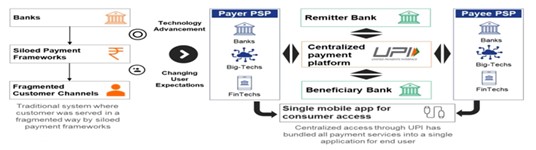
After the launch, the demonetization and COVID-19 pandemic boosted the adoption of UPI in the Indian financial market among individuals, merchants, and governments. Simultaneously, Third-Party App Providers such as Google Pay, PhonePe, Paytm, etc., began concentrating their roots in India’s digital payment market share in 2017-18. This chart illustrates that UPI is a centralized Application Programming Interface (API) payment platform that provides seamless interoperable transactions between sender and receiver, replacing fragmented, siloed payments. The UPI system notifies the banks to transfer the amount instantly in the virtual space.
Source: National Payments Corporation of India (2023)
Source: Department of Financial Services (n.d.)
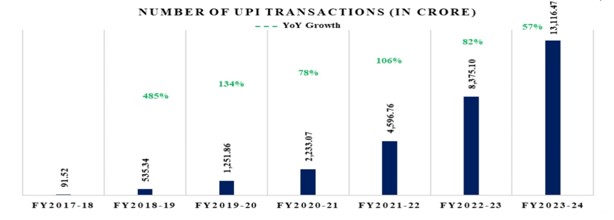
This graph showcases a record-breaking boom of UPI transactions, leading from 91.52 crore to 13,116 crore, which has definitely revolutionized India’s financial market. In recent years, the growth of UPI has happened due to the user-friendly approach of UPI to conduct small-scale pay transactions among customers, which has increased the volume and value of transactions in India.
A. UPI & India’s Stack Knowledge Programme
India Stack is an open APIs digital public infrastructure that includes 3 core layers – identity, payment, and data (Manjunath et al., 2024). In 2009, India Stack began with the Aadhaar project, the world’s largest biometric digital identity system, with over 1.4 billion users by 2025 (Banking Frontiers, 2023; Unique Identification Authority of India, n.d.). The next phase, Unified Payments Interface (UPI), rapidly transformed the Indian financial banking system, providing an interoperable payment transaction with 684 live banks, exceeding a volume of 20 million in November 2025 (National Payments Corporation of India, n.d.; Watson, 2024). The third component is the Data Empowerment and Protection Architecture (DEPA), a personalized cloud data storage, like Digilocker (Watson, 2024). On July 7 – 9, 2022, India Stack Knowledge Exchange Programme applauded India Stack’s move beyond Indian jurisdiction towards international expansion (Press Information Bureau, 2022). According to Press Information Bureau (2023), “India signed MoU with three countries namely Armenia, Sierra Leone, and Suriname on sharing INDIA STACK i.e. successful digital solutions implemented at population scale”. This leads India’s exportation of the Global Digital Public Goods Repository to emerge international digital technology leader.
India’s Digital Diplomacy: A Theoretical Perspective
Joseph Nye’s book “Soft Power: The Means to Success in World Politics,” had defined and widened the term ‘soft power’ in the aftermath of the Iraq-US (2003) war. The book emphasized that the usage of soft power is essential for establishing oneself as a global hegemon in the competitive world politics. According to Nye (2004), “Soft power is getting others to want the outcomes that you want co-opts people rather than coerces them” (p.5). This statement highlights the potential of soft power to achieve self-interest outcomes from others through attraction rather than force. Similarly, India’s UPI has been adopted by various countries through self-acceptance rather than India’s external pressure. In this approach, 8 countries have incorporated UPI in their regional payment system, boosting the gateway for the international financial system.
Joseph Nye’s theory suggests India has observed high demand for UPI adoption in many countries such as Oman, Cyprus, Japan, and others (Embassy of India, Muscat, 2022; ET Online, 2025; Laskar, 2025). According to Prime Minister Narendra Modi, “The Unified Payments Interface (UPI) developed by India is a huge success story and has been adopted in many countries. Last year, together with His Highness Sheikh Mohamed, it was launched in the UAE as well. We can also cooperate with other BRICS countries in this area.” (Ministry of External Affairs, 2024, PM Modi, 2024). This statement highlights that India’s UPI is shifting the multipolar world order towards virtual space and emphasizing India’s emerging leadership towards BRICS countries as a trustworthy and cooperative-driven country.
Nye’s theory includes three elements of soft power, i.e., culture, value and policy legitimacy. India’s UPI promotes a culture of global public good as a trustworthy and reliable partner for financial cooperation in different countries. Simultaneously, India’s digital culture presents the transformational shift of India’s global leadership in digital payment systems from ‘Digital Vishwaguru’ to ‘Digital Vishwamitra’ for the world. Not as a ‘World Teacher’ but as a ‘World Friend’, especially for small nation states (Ghosh, 2025). Further, the UPI holds key value of real-time payment system for instant transfer, availing low-cost facility through zero Merchant Discount Rate (MDR), offering ease of use system for efficient services, etc., ultimately aims for global financial inclusion (National Payments Corporation of India, 2023; World Bank, 2021). The policy legitimacy brings up the concept of ‘One Digital Family’ by offering UPI for the Global South through signing MoUs with multiple countries, organizations, and companies to foster a digital payment system.
Further, the limitation of the theory discusses that soft power is attractive but it is optional, not mandatory, for countries risking alternative production of the digital payment system by others, such as cases where the UPI payment system faces obstacles towards unchallengeable alternatives, like in the USA MasterCard, Brazil PIX payment system, and others.
Global Expansion of India’s UPI:
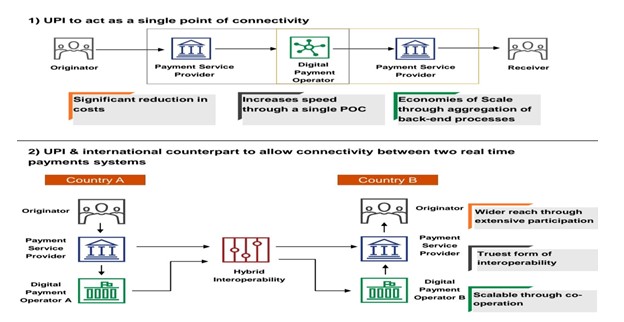
On 3 April 2020, the establishment of NPCI International Payments Limited (NIPL), a subsidiary of NPCI, introduced a gateway for India’s UPI in the global financial market. The vision statement of NIPL embarks “To be a leader in empowering global citizens with accessible digital payment solutions” (NPCI International Payments Limited, n.d.). In 2018, India-Singapore fintech collaboration of RuPay International card and SBI’s UPI-based remittance app during Prime Minister Narendra Modi’s visit rooted India’s UPI expansion on the international payment system (High Commission of India, Singapore, 2019; PTI, 2018). In 2021, Bhutan became the first country to accept and adopt the UPI payment system. Since then, Nepal, the UAE, Singapore, France, Sri Lanka, Mauritius, and Qatar, initiated India’s digital payment leadership across the globe. This chart explains the international working structure of India’s UPI. The UPI system works on hybrid interoperability in a single point of connectivity between two different countries based on their regional system. For example, Indian tourist Ramesh bought chocolates in Nepal. The payment service providers (Paytm, NEPALPAY Business) of both countries sent a notification of the amount transfer to the respective banks (SBI, Nepal Bank Ltd.) and digital payment operators (NPIL, Fonepay Payment Service Ltd.) communicate for transactions. Once approved, the amount is immediately deducted from Ramesh’s Indian bank account and sent to the merchant’s Nepal bank account by calculating Nepalese Rupees (NPR) through the local clearing system. This is called cross-border payment transactions among different countries.
Source: National Payments Corporation of India (2023)
Source: Ministry of Finance, Government of India (2025)2
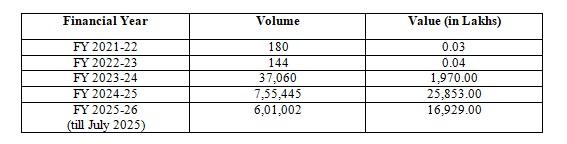
The table represents the cross-border transactions of India’s UPI globally. The figures in the table illustrate that the initial growth of cross-border payment had lower volume and value of transactions due to the COVID-19 Pandemic. However, the post-COVID era has marked significant progress of the digital payment system in the international market in terms of payment transactions.
Achievements
A. Rapid Expansion of UPI Global
In 2025, 8 countries have officially accepted India’s UPI in their regional digital payment system (NPCI International Payments Limited, n.d.). On 12 February 2024, India’s UPI services were officially launched in Sri Lanka and Mauritius during a virtual joint ceremony of the three nations. The President of Sri Lanka said, “You no longer have coins, you have Lanka QR and NIPL together” (Reserve Bank of India, 2024). Whereas, the Prime Minister of Mauritius stated, “The Bank of Mauritius has taken the modernization of the payment infrastructure to a higher level with the collaboration of National Payments Corporation of India” (Reserve Bank of India, 2024). This highlights that UPI enhances India’s global image across the world, especially in the Global South.
B. Ensure Trustful & Cooperative Financial Partnership
During the G-20 Summit 2023 PM Modi stated, “India has created a highly secure, highly trusted, and highly efficient public digital infrastructure in its digital payments ecosystem” (Ministry of External Affairs, 2023). Similarly, in Global Fintech 2025 PM Modi states, “Today’s India is among the most technologically inclusive societies in the world, Friends, we have democratized digital technology as well….and made it accessible to every citizen and every region of the country. Today, it has become the hallmark of Bharat’s good governance model (PM Modi, 2025).
These statements signify India aims inclusivity of all, including sharing a trustworthy and cooperative financial partnership through the UPI digital payment system in the world, emphasizing the idea of “One Earth, One Family, One Future”.
C. Unique Position of India’s Digital Payment System
The success rate of UPI in India’s regional payment transactions has increased trust and confidence among various countries. According to the ACI Worldwide report (2024), India stands as the largest real-time payment transactions (129.3B) compared to Brazil (37.4B) and Thailand (20.4B) in 2023. Whereas, at the 2022 G-20 Bali summit PM Modi stated, “Last year, over 40 percent of the world’s real-time payment transactions took place through UPI. Similarly, we opened 460 million new bank accounts on the basis of digital identity, making India a global leader in financial inclusion today” (Ministry of External Affairs, 2022) had unlocked UPI’s unique features of instant payment transfer, interoperability, modular & open-source tech stack, lower transaction fees, and convenience (National Payments Corporation of India, 2023, p. 29). All these lead India’s UPI to challenge digital and financial hegemons like the USA, China, Brazil, and others.
Challenges
A. UPI Bares Criticism
According to the Office of the United States Trade Representative (2025), “In November 2020, the state-owned National Payments Corporation of India (NPCI) announced a market share limitation of 30 percent (measured by transactions) for foreign electronic payment service suppliers processing online payments made through India’s Unified Payment Interface, which is owned and operated by NPCI. Foreign digital payment companies were given until January 2023 to ensure their market shares met the 30 percent limit, but the Ministry of Finance has not enforced this market share ceiling” (p. 207). The United States’ criticism advocates India’s UPI leverages a geo-economic tool for acquiring a global digital payment system by restricting the share of foreign payment companies in India and expanding self-reliant UPI in the world.
B. Cybersecurity Breach
Cybersecurity breach is a major concern for India’s UPI expansion in the globe. According to Press Information Bureau (2025a), India’s general cyber fraud has risen from 10.29 lakh in 2022 to 22.68 lakh in 2024. Internationally, according to a Times of India report, “Maharashtra Cyber Department has collated information that in last 4-5 days, cyber resources on cyberspace of India especially related to information, infrastructure and banking have been under attack from China. The number of attacks has increased,” said Yashasvi Yadav, Inspector General (IG), Maharashtra State Cyber Department (ANI, 2020). Although this indicates India has not faced a major cybersecurity breach in the UPI payment system. Yet, these examples illustrate that UPI needs a robust cybersecurity system for tackling future cyber challenges.
C. Emergence of Alternative Payment Systems
According to the ACI Worldwide report (2024), Brazil has seen a 77.9% rise compared to 44.6% in India in the YoY growth rate of Volume of Real-Time Payments in 2022-2023, though positioning second-highest real-time payment system after India. The rapid expansion of Brazil PIX has increased the alternative competition of the digital payment system against India. However, PIX lack multi-currency support (a single transaction containing multiple currencies), which has edged India’s UPI (Chandra et al., 2024, Part 1, p.12). Others include Fed Now (America), WeChat Pay and Alipay (China), M-Pesa (Kenya), and Faster Payments Service (UK’s FPS) emerging as a major contender for India’s UPI for establishing the global digital payment leadership.
Discussion and Findings
A. Data Interpretation and Analysis
The data analysis investigates the growing perception of bankers and youths to strengthen this literature and encapsulate their insight on the rise of UPI and its impact on India’s emerging leadership in the global digital payment system. The primary data collection of bankers and youths includes 14 responses & 35 responses respectively.
Bankers Perceptions
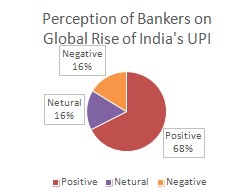
Fig.1.
This chart illustrates positive perception of bankers on global rise of India’s UPI. The bankers’ perception is essential because they are key technical intermediaries managing India’s financial sector at the grassroots level for digital transactions and provides realistic insights into how UPI works in India and expands in the world.
Youths Perceptions
The pie chart showcase youths are also positively driven on global expansion of UPI because India is a youth-driven country and youths are exponential contributors to UPI transactions in India; this success story inspires other nation-states’ youngsters to demand the adoption of the UPI system in their region
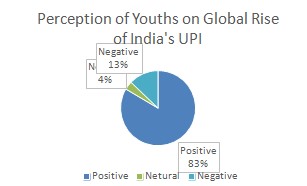
Fig.2.
Findings
a. India’s UPI as a Digital Diplomacy shapes India’s Foreign Policy
Since the introduction of UPI, India’s financial sector has significantly transformed into a digital economy and influenced its global politics. “UPI has become the world’s largest platform for payments—compared to Visa’s 639 million daily transactions in 2024, UPI recorded 644 million on 1 June 2025 and 650 million on 2 June” (Chikermane, 2025). Simultaneously, Chikermane (2025) indicates UPI leverages India’s Grand Strategy for collaborating global digital payment system.
Meanwhile, the Fintech innovation has influenced India’s inclusive presence in the international digital market. In 2022, India and Singapore signed a FinTech Co-operation Agreement (CA), which builds cross-border collaboration in Fintech innovations progressing towards global fintech cooperation (Monetary Authority of Singapore & International Financial Services Centres Authority, 2022). These events signified the strategic importance of India’s UPI as digital diplomacy shapes India’s foreign policy.
b. India Stack serves Global Digital Public Goods in a Multipolar World Order
India Stack is a digital public infrastructure that builds 3 core layers of identity (Aadhaar), payment (UPI), and data (Digilocker). Nandan Nilekani (2023) said, “India’s unique contribution to digital public infrastructure, and therefore, there is a major move afford to take this model to 50 countries in five years” (Nandan Nilekani, 2023). The success of India’s Digital Public Infrastructure encouraged global adoption. However, PM Modi advocate, “India Stack is a beacon of hope for the world, especially for the nations of the Global South” (Press Information Bureau, 2025b) and the IMF report highlighted, “India has developed a world-class digital public infrastructure (DPI) to support its sustainable Development goals” (Alonso et al., 2023). This statement justifies India Stack serves as global digital public goods initiating India has digitally leading player in the multipolar world order.
c. UPI builds India’s Robust Soft Power Perception Across the Globe
UPI builds India’s robust soft power perception across the globe, the finest example befits French President Emmanuel Macron said, “I will not forget the chai we shared together close to the palace (Hawa Mahal). It was a chai paid with UPI” during his official visit to India on 26 January 2024 (Mohan, 2024). Also, Mr. Wayne Nakhid, Deputy National Chief Digital Officer of Trinidad and Tobago, said, “The UPI programme is a step forward, a step into the future that our people need, want, and deserve” (Ministry of Public Administration and Artificial Intelligence, 2024). This explains India’s global image has positively grown in Western and African countries, emphasizing that India’s soft power perception is acknowledged worldwide.
d. Global Financial Inclusion is a key persistent challenge for India’s UPI
The key challenges include the inclusion of global real-time payment settlement, the lack of digital sovereignty, regulatory hindrances, technological disparities, different foreign media perceptions, etc. For instance, The Guardian report states ‘They treat us like animals’, showcasing negative connotations of India’s e-commerce market. However, India’s UPI gained good popularity, stating ‘UPI has brought a leapfrogged transition in linking millions of Indians’ bank accounts to apps, and smaller items can be paid through a QR code on a mobile’ (Ellis-Petersen, 2023). While China Daily states, “China’s mobile payment is leading the world in both market size and user numbers and Chinese mobile payment companies have stepped up efforts to expand their presence in overseas markets” (Fan, 2019), such mixed claims from different countries hinder India’s progress towards secured global financial inclusion.
India’s UPI set a unique position for global expansion establishing its emerging leadership in the international financial system. India believes in its own technology, which inculcates the idea of indigenous knowledge exported to the world by Tilak’s Swadeshi slogan. This conception situates a similar idea of India’s UPI as a globalized product, advocating for an efficient, cost-effective, and faster payment system for the global financial system. This notion has developed the positive image of India as the regional self-reliance product is not only utilized for Indian citizens but also aids other countries’ progress for a better global digital system without a realistic perception. This aims to position India as a trusted, reliable, and cooperative state for global development, signifying the concept ‘Digital Vishwamitra’ across the globe. Whereas the Youth have confidence in India’s UPI growth in the global system, yet a certain skeptical perception remains. For instance, UPI’s success is undeniable, but issues like transaction failures and the need for better cybersecurity measures still need attention. This justifies that India has the capability for achieving global digital payment leadership, yet India needs close watch to address key challenges for attaining the goal.
Conclusion
The emergence of the 21st Century has introduced greater competition among major powers for establishing hegemonic power in the multipolar world order. According to Ian Bremmer (2024), there are three forms of world orders, i.e., security, economic, and digital. He says, “The digital order is coming soon and even more important, because it provides a way for a techno-polar order dominated by technology companies rather than the states”. This statement is justified as India, the US, China, Brazil, Europe, and others are in a winning race in specialized fields. For example, the US in military and economic power, Russia in oil & natural resources, Europe in trade & commerce, and China in manufacturing and science & technology. Similarly, India has also cultural & demographic power; however, India also explores the fintech arena through UPI. The rapid growth of UPI in India and its global reach has a significant impact on world politics. This brought the digital revolution in the contemporary era; India’s UPI stands for digital economy through the promotion of digital diplomacy. As, Amitabh Kant exclaimed, “From India to the world, UPI is leading the digital payment revolution!” (TOI Business Desk, 2025). Meanwhile, UPI is a niche product that emerged from India Stack, a digital public infrastructure that advocates for global public goods.
In May 2024, Ghana-India has signed an agreement between Ghana’s GhIPSS (Ghana Interbank Payment and Settlement Systems) & India’s UPI for operationalizing the cooperative instant payment system (Ricci et al., 2025, p. 39). Whereas, Euro’s Target Instant Payment Settlement (TIPS) and India’s Unified Payments Interface (UPI) initiated the “realisation phase” to interlink both systems, enabling an instant cross-border payment system, and also aiming for the initiation of Nexus Global Payments to integrate the global payment system in November 2025 (European Central Bank, 2025). This shows India’s global leadership in the Global South is also emerging along with the Global North’s appreciation, showcasing India’s shift from ‘Digital Vishwaguru’ to ‘Digital Vishwamitra’.
India’s ancient ideology, expressed in S. Jaishankar’s (2024) book, “Why Bharat Matters”, situates the arrival of 2014 Modi’s foreign policy, which introduced India as Bharat in the contemporary era. The terms Global South, Global Good, AatmaNirbhar Bharat, and South-South cooperation in the book resonate with India as a trustworthy & cooperative partner. The book in builds ancient Bharat has always remained a reliable partner through trade and commerce, similarly, Bharat is liable for digital economic partnership in contemporary times. Also, Maya Chadda (2014), in her book “Why India Matters”, figures out that the role of regional coalition government has always strengthened the economic and foreign policy of India for progressing India’s soft power assets – cultural and civilization, diaspora, and democracy, to make India a world leader.
This changing international political economy shapes the sphere of the world order bringing a scope for the research. Hence, this research article investigates how India’s digital diplomacy utilizes UPI as a soft power tool to shape its emerging leadership in the global digital payment system.
End Notes:
1. National Payments Corporation of India (2023, p.26).
2. The UPI Cross-Border transactions data of 7 countries i.e. the UAE, Nepal, Bhutan, Singapore, Mauritius, France and Sri Lanka are available, except Qatar. Because Qatar has incorporated UPI recently on 6 October 2025 and the availability of Qatar’s data is limited.
References:
ACI Worldwide. (2024). Prime time for real-time: The 2024 global real-time payments report. https://www.aciworldwide.com/wp-content/uploads/2024/09/2024-Prime-Time-for-Real-Time-Report.pdf
Alonso, C., Bhojwani, T., Hanedar, E., Prihardini, D., Una, G., & Zhabska, K. (2023). Stacking up the benefits: Lessons from India’s digital journey (IMF Working Paper No. 23/78). International Monetary Fund. https://www.imf.org/-/media/files/publications/wp/2023/english/wpiea2023078-print-pdf.pdf
ANI. (2020, June 24). Maharashtra Cyber Cell warns of large-scale bank-related cyber attacks originating from China. The Times of India. https://timesofindia.indiatimes.com/gadgets-news/maharashtra-cyber-cell-warns-of-large-scale-bank-related-cyber-attacks-from-china/articleshow/76588637.cms
Banking Frontiers. (December 20, 2023). India Stack – on way to become a global platform. https://bankingfrontiers.com/india-stack-on-way-to-become-a-global-platform/
Berridge, G. R., & James, A. (2003). A Dictionary of Diplomacy (2nd ed.). Palgrave Macmillan.
Bjola, C., & Manor, I. (Eds.). (2024). The Oxford handbook of digital diplomacy. Oxford University Press.
Chadda, M. (2014). Why India Matters. Lynne Rienner Publishers.
Chandra, K., Jayakrishnan, A., Fernandes, R. B., de Paulo, C. B., Boéchat, P., & Kashyap, S. (2024, September 20). Successful Design of Open Finance: Lessons from India and Brazil. Centre for Digital Public Infrastructure. https://cdpi.dev/wp-content/uploads/2024/09/DPI-for-Open-Finance-A-case-study-on-UPI-Pix-1.pdf
Chikermane, G. (2025, June 7). Having achieved scale, UPI must power India’s grand strategy. Observer Research Foundation. https://www.orfonline.org/expert-speak/having-achieved-scale-upi-must-power-india-s-grand-strategy
Constantinou, C. M., Kerr, P., & Sharp, P. (2016). The SAGE handbook of diplomacy. SAGE Publications.
Department of Financial Services. (n.d.). Growth of Various Modes of Digital Payment. Government of India. https://financialservices.gov.in/beta/en/page/growth-various-modes-digital-payment, Access date: 30 November 2025.
Ellis-Petersen, H. (2023, July 30). Innovation and exploitation: India’s e-commerce boom threatens to upend local businesses and workers’ rights. The Guardian. https://www.theguardian.com/world/2023/jul/30/innovation-and-exploitation-indias-e-commerce-boom-threatens-to-upend-local-businesses-and-workers-rights
Embassy of India, Muscat. (2022, October 4). Milestone MoU signed for acceptance of RuPay card and UPI QR Code-based mobile payments in Oman [Press release]. https://www.indemb-oman.gov.in/news_letter_detail.php?id=244
ET Online. (2025, October 19). Indian tourists travelling to Japan will soon be able to make payments using UPI. The Economic Times. https://www.economictimes.indiatimes.com/nri/invest/indian-tourists-travelling-to-japan-will-soon-be-able-to-make-payments-using-upi/articleshow/124682824.cms
European Central Bank. (2025, November 20). Eurosystem moves forward on work to connect TIPS with India’s Unified Payments Interface and with Nexus Global Payments. https://www.ecb.europa.eu/press/intro/news/html/ecb.mipnews251120.en.html
Fan, F. (2019, August 8). Technology firms eye sweet spot in Indian digital payment market. China Daily. https://www.chinadaily.com.cn/a/201908/08/WS5d4b61e3a310cf3e355647b4.html
Ghosh, S. (2025, August 21). Why has India reimagined its role from Vishwaguru to Vishwamitra? The Interpreter. Lowy Institute. https://www.lowyinstitute.org/the-interpreter/why-has-india-reimagined-its-role-vishwaguru-vishwamitra
Gilboa, E. (2016). Digital diplomacy. In C. M. Constantinou, P. Kerr, & P. Sharp (Eds.), The SAGE handbook of diplomacy (pp. 540–551). SAGE Publications.
High Commission of India, Singapore. (2019, November). Pilot launch of BHIM QR in Singapore. https://www.hcisingapore.gov.in/press?id=eyJpdiI6IlhvK3RydUVKYnZLRnR1NHhnTHdQb3c9PSIsInZhbHVlIjoiVitXaUxYSE5IMmlVVVYxc1F5dWFFQT09IiwibWFjIjoiMWMwY2NmOTJhNDFhZGEzZmE4MjdkNWZlYWJjMTY3ZTVjNjRlOTI4Njg1Y2E5N2VjZjM4YzZjMjZkYTkyMDU0NSJ9, Access date: 02 December 2025
Ian Bremmer, (2024, 7 June), Ian Bremmer on “The Next Global Superpower Isn’t Who You Think,” in TED, https://youtu.be/uiUPD-z9DTg, Access date: 14 November 2025
Kumar, A. (2025, September 25). UPI goes live in Qatar, starting with duty-free stores at Hamad airport. Business Standard. https://www.business-standard.com/finance/personal-finance/qatar-becomes-eighth-country-to-accept-upi-how-step-will-help-indians-125092500857_1.html
Jaishankar, S. (2024). Why Bharat Matters. Rupa Publications.
Laskar, R. H. (2025, June 16). MoU signed to introduce UPI services in Cyprus. Hindustan Times. https://www.hindustantimes.com/india-news/mou-signed-to-introduce-upi-services-in-cyprus-101750084013888.html
Manjunath, G., Paramashivaiah, P., & Nellore, C. P. (2024). India Stack: A paradigm shift in digital governance (Global Innovations for Sustainable Development, Chapter 03). Himalaya Publishing House Pvt. Ltd. Available at SSRN: https://doi.org/10.2139/ssrn.4781463
Ministry of External Affairs. (2022, November 16). English translation of Prime Minister Shri Narendra Modi’s address at the G-20 Summit in Bali, Session III: Digital Transformation. https://www.mea.gov.in/Speeches-Statements.htm?dtl/35888/English_translation_of_Prime_Minister_Shri_Narendra_Modis_address_at_the_G20_Summit_in_Bali_Session_III_Digital_Transformation
Ministry of External Affairs. (2023, February 24). PM addresses first meeting of Finance Ministers and Central Bank Governors under India’s G20 Presidency. G20 India. https://www.g20.in/en/media-resources/press-releases/february-23/fmcbg1.html, Access Date: 27 December 2025.
Ministry of External Affairs. (2024, October 23). English translation of Prime Minister’s remarks at the Open Plenary of the 16th BRICS Summit. https://www.mea.gov.in/Speeches-Statements.htm?dtl/38453/English_Translation_of_Prime_Ministers_Remarks_at_the_Open_Plenary_of_the_16th_BRICS_Summit
Ministry of Finance, Government of India. (2025). Unstarred Question No. 3493: Data on cross-border UPI transaction [Parliamentary question & answer]. Sansad.in. https://www.sansad.in/getFile/loksabhaquestions/annex/185/AU3493_IxuDsb.pdf?source=pqals
Ministry of Public Administration and Artificial Intelligence. (2024, September 27). The Ministry signs agreement for real-time payment platform. Government of the Republic of Trinidad and Tobago. http://mpaai.gov.tt/news/ministry-signs-agreement-real-time-payment-platform
Mohan, G. (2024, January 27). Chai with PM Modi, paid through UPI, ‘unforgettable’ memory for President Macron. India Today. https://www.indiatoday.in/india/story/emmanuel-macron-pm-modi-upi-chai-republic-day-chief-guest-jaipur-france-2494286-2024-01-27
Monetary Authority of Singapore & International Financial Services Centres Authority. (2022, September 18). MAS and IFSCA to pursue cross-border FinTech innovations [Joint media release]. https://www.ifsca.gov.in/Document/Legal/mas-ifsca-joint-media-release_mas-and-ifsca-to-pursue-cross-border-fintech-innovations_18-sep-22_final18092022030404.pdf
Nandan Nilekani, (2023, 27 August), Nilekani speech on “India’s Digital Revolution: Nandan Nilekani gives the big picture at B20 Summit”, in New Delhi, https://www.youtube.com/live/XH2VTFYU9vI?si=JxXmnemMa1S3Mt7M, Access Date: 30 December 2025
National Payments Corporation of India. (2023, December 6). Unified Payments Interface (UPI): A payment solution designed to transform economies of the 21st century [White paper]. NPCI. https://www.nipl.com/uploads/UPI_A_payment_solution_designed_to_transform_21st_Century_economies_f1fbdee7e7.pdf
National Payments Corporation of India. (n.d.). Unified Payments Interface (UPI) product statistics. NPCI. https://www.npci.org.in/what-we-do/upi/product-statistics/ Accessed Date: 24 December 2025.
NPCI International Payments Limited. (n.d.). NIPL. https://www.nipl.com/, Accessed Date: 27 December 2025.
Nye, J. S. (2004). Soft power: The means to success in world politics. PublicAffairs.
Office of the United States Trade Representative. (2025). 2025 National Trade Estimate Report on foreign trade barriers: Report of the President of the United States on the trade agreements program [Press Report]. USTR. https://ustr.gov/sites/default/files/files/Press/Reports/2025NTE.pdf
PM Modi, (2024, October 23), PM Modi speech on “financial integration among BRICS countries and cross-border payments,” in BRICS Leaders’ Summit in Kazan, Russia, https://youtu.be/a-Z_K2W3p2M?si=k9_CR8hqn5WopqEs, Access date: 21 September 2025
PM Modi, (2025, October 9), PM Modi speech on address “India’s digital ecosystem is setting global standards for innovation and inclusion” in 6th edition of the Global Fintech Fest 2025 in Mumbai, https://youtu.be/NfwpUy7TWwc, Access date: 27 December 2025
Press Information Bureau. (2022, July 10). India Stack Knowledge Exchange 2022 concludes (Press Release ID: 1840569). Government of India. https://www.pib.gov.in/PressReleaseIframePage.aspx?PRID=1840569®=3&lang=2
Press Information Bureau. (2023, June 12). Global DPI Summit and Global DPI Exhibition inaugurated by Rajeev Chandrasekhar; India signs MoU with Armenia, Sierra Leone & Suriname on India Stack (Release ID: 1931731). Government of India. https://www.pib.gov.in/PressReleasePage.aspx?PRID=1931731®=3&lang=2
Press Information Bureau. (2025a, October 8). Curbing cyber frauds in Digital India (Release ID: 2176146). Government of India. https://www.pib.gov.in/PressReleasePage.aspx?PRID=2176146®=3&lang=2
Press Information Bureau. (2025b, October 9). Prime Minister Shri Narendra Modi addresses the Global Fintech Fest 2025 in Mumbai. Prime Minister’s Office. https://www.pib.gov.in/PressReleasePage.aspx?PRID=2176893
PTI. (2018, May 31). PM Modi launches 3 Indian digital payment apps in Singapore. Times of India. https://timesofindia.indiatimes.com/india/pm-modi-launches-3-indian-digital-payment-apps-in-singapore/articleshow/64403855.cms
Reserve Bank of India. (February 12, 2024). Launch of India’s Digital Payments Connectivity with Mauritius and Sri Lanka. https://www.youtube.com/live/gqcjqyTWKF8?si=vzBElTiKpuYlZcIT, Access Date: 04 December 2025.
Ricci, L. A., Ahokpossi, C., Quayyum, S. N., Turk, R. A., Belianska, A., Cangul, M., Fuje, H., Lee, S., Li, G. B., Li, X., Mu, Y., Mwase, N., Ree, J. J., Shi, H., & Kramarenko, V. (2025). Digital payment innovations in Sub-Saharan Africa (eISBN: 9798400232220). International Monetary Fund. https://www.elibrary.imf.org/view/journals/087/2025/004/article-A001-en.xml
Second Administrative Reforms Commission. (2008). Promoting e-Governance: The SMART way forward — Eleventh report. Department of Administrative Reforms & Public Grievances, Government of India. https://darpg.gov.in/sites/default/files/promoting_egov11.pdf
TOI Business Desk. (2025, July 15). UPI revolution: Surpasses Visa with 650 million daily transactions; ‘leading the digital payment revolution,’ says Amitabh Kant. Times of India. https://timesofindia.indiatimes.com/business/india-business/upi-revolution-surpasses-visa-with-650-million-daily-transactions-leading-the-digital-payment-revolution-says-amitabh-kant/articleshow/122421901.cms
Unique Identification Authority of India. (n.d.). Aadhaar Dashboard. Government of India. https://uidai.gov.in/aadhaar_dashboard/index.php, Accessed Date: 24 December 2025.
Watson, E. (2024, March). The India Stack as a potential gateway to global economic integration (ORF Issue Brief No. 700). Observer Research Foundation. https://www.orfonline.org/public/uploads/posts/pdf/20240322085417.pdf
World Bank. (2021, October). IMPS and UPI | India FPS: Case Study (Fast Payments Toolkit). https://fastpayments.worldbank.org/sites/default/files/2021-10/World_Bank_FPS_India_IMPS_and_UPI_Case_Study.pdf
