
Abstract
This article traces the evolving roles of drones between India and Pakistan. It briefly analyses the military drone programmes and capabilities of India and Pakistan, and provides the trajectory of the evolution of drones from being primarily used for surveillance purposes to now cross-border smuggling of drugs and weapons and precision strikes during military operations. It also highlights the deployment of drones during Operation Sindoor in the May 2025 conflict between India and Pakistan, and how this has underscored the necessity of drone capabilities as an essential requirement on the battlefield.
Keywords: Drones, India, Pakistan, Operation Sindoor, Surveillance, UAV
Introduction
Unmanned Aerial Vehicles (UAVs), commonly known as drones, have come to acquire a significant place in modern warfare. Their proven efficiency, low cost, and reduced risk to the pilot make them a highly desirable technology among various state and non-state actors across the world. It would not be an exaggeration to say that no battle in contemporary times can be effectively fought without the application of drones in one way or another. Be it for surveillance or strike purposes, drones come in handy in various multidomain operations. Most importantly, drones are no longer concentrated in just a few regions or countries, such as the US and Israel. At present, more than 50 countries have acquired MALE-class armed drones. This number had not crossed even double digits around 2010, which explains the exponential rise in the military application of drones across the world. Furthermore, the speed of drone proliferation among Violent Non-State Actors (VNSAs) has surpassed its diffusion and proliferation among states. From the launch of the US-led “War on Terror” in 2001 to the Armenia–Azerbaijan war, the Russia–Ukraine conflict, and the India–Pakistan conflict, among others, drones have proven to be a frontline necessity in modern warfare. Against this backdrop, this article highlights the evolving role of drones in the India–Pakistan scenario, from being primarily used for surveillance to their use in smuggling and strikes, thereby marking a significant shift and advancement in the way this technology is being deployed
Drone Programmes in India and Pakistan
The history of the development of drone programmes for military purposes in India and Pakistan began around the 1980s and 1990s. India’s drone programme was initially started by the DRDO with the development of drones such as Lakshya and Nishant. Indigenously built suicide drone, such as Nagastra-1 and Archer-NG armed tactical drones, have demonstrated their capabilities. This capacity is further buttressed by the development of various swarm drones. It made significant strides in developing the first combat drone, called Rustom-II (TAPAS BH-2021), and DRDO Ghatak; however, they remain in the prototype stage and have yet to meet the operational requirements of the Indian Armed Forces. India imported Searcher and Heron drones from Israel, providing a significant push to its ISR capabilities. The deal worth US$4 billion signed with the United States to acquire 31 Predator MQ-9B drones shall further strengthen its drone capability. In addition to its public sector, India has a vibrant private sector that has been manufacturing military-grade drones. Companies such as ideaForge, Zen Technologies, Adani Defence, and Garuda Aerospace, among others, are taking the lead in this direction. Furthermore, the Drone Rules, 2021, the ban on imported items except for defence and security purposes, and initiatives such as Drone Shakti Mission, Innovations for Defence Excellence (iDEX) and the Production Linked Incentive (PLI) have further incentivised manufacturers toward indigenous production. However, it is pertinent to note that, despite these measures, India continues to remain dependent on foreign countries, mainly China and Taiwan, for key components such as sensors, motors, cameras, batteries, and chips used in drone manufacturing. Nearly 39 per cent of flight controllers used in India’s smaller drones originate from Chinese manufacturers1.
Reliance on external players for the supply chain during times of conflict could become an obstacle due to disruptions of the supply chains and their potential weaponisation by the adversary. The large-scale indigenous final stage production of drones should not be the only priority. Therefore, as Anuj Budhiraja, Vice President, Phillips Additive argues that India has a brief but crucial window of opportunity to take the lead in the global drone economy. The nation must prioritize three enablers in order to take advantage of this opportunity: expanding precise manufacturing capabilities, bolstering domestic supply chains for essential components, and funding workforce development through focused skilling programs and technical education2. Because developing a strong and competitive domestic drone ecosystem is a strategic vision rather than just a technological objective3. This is particularly imperative, as drones are vulnerable to security breaches through embedded malware.
Drone strikes in Pakistan are not a new phenomenon. Post 9/11, the US launched various drone strikes in Federally Administered Tribal Areas (FATA) along Pakistan’s northern border with Afghanistan to kill the terrorist hideouts belonging to Osama Bin Laden4. Moreover, the Pakistan army has been using drone strikes to kill and neutralise the insurgents operating inside Pakistan, particularly the Pakistani Taliban groups in the Khyber Pakhtunkhwa province bordering Afghanistan. Likewise, militant groups have carried out drone strikes to target the security personnel in the region5. The first drone strike by the Pakistani army was announced in the year 2015 when it claimed to have neutralised militants in North Waziristan6.
Pakistan developed its first Unmanned Combat Aerial Vehicle (UCAV) or combat drone in 2009, named ‘Burraq’. It is named after a mythical character in Islam that is said to have transported the Prophet Muhammad to heaven. Pakistan has also developed indigenous drones of the Shahpar series. As shown in Table 1, Pakistan’s drone capability is greatly backed by support from Turkey and China. From Turkey, Pakistan has acquired the Bayraktar TB2 MALE UCAV and Akinci, a HALE UCAV. Both Turkey and Pakistan are in an advanced stage of finalising a deal related to the co-production of Turkish drones in Pakistan. This will, on the one hand, help Ankara expand its market and, on the other hand, strengthen Pakistan’s drone capability. Likewise, Pakistan has acquired the Rainbow series and Wing Loong series of drones from China. Thus, China has become not only the largest overall arms supplier to Pakistan but also its largest drone supplier.
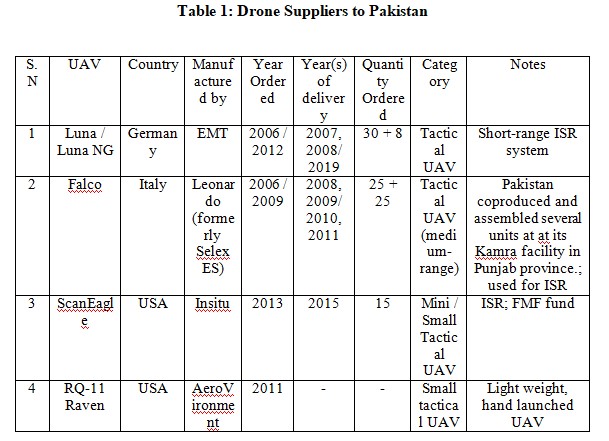
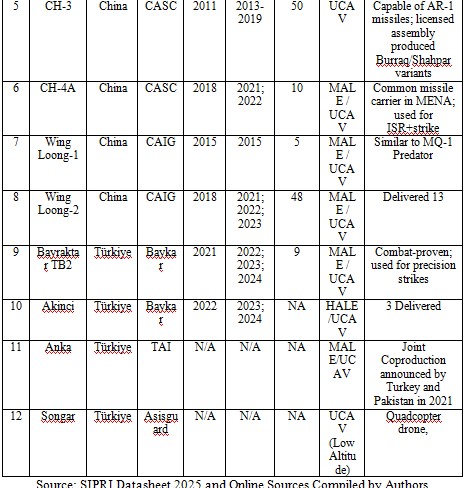
Note:
CASC= China Aerospace Science and Technology Corporation
CAIG= Chengdu Aircraft Industry Group. CAIG is a division of the Aviation Industry Corporation of China (AVIC).
TAI= Turkish Aerospace Industries (TAI)
Drones in India-Pak Rivalry
For a long time, drones have been used for surveillance and reconnaissance purposes across the India–Pakistan border by both countries. The Kargil Review Committee highlighted the importance of UAVs in preventing unwanted incursions from Pakistan. It was observed that, had better surveillance systems been in place, illegal Pakistani incursions into Indian territory could have been detected at an early stage. Since then, drones have come to be recognised as an important tool in the arsenal of the modern military. Neither country has a specific “drone doctrine” in existence yet, but drones are becoming an important aspect of their overall military doctrines. Drones were initially limited to surveillance purposes; however, their rapid proliferation among terrorist organisations has made them an instrument for smuggling weapons and drugs. This has been further enabled by the easy availability of civilian drones, which are customised to achieve specific objectives. The attack on the Indian Air Force station in Jammu in 2021 by explosive-laden drones was the first drone attack of its kind on Indian territory7. Although no casualties were reported, it caused serious rethinking around the real threat the drone had come to posed to India’s security
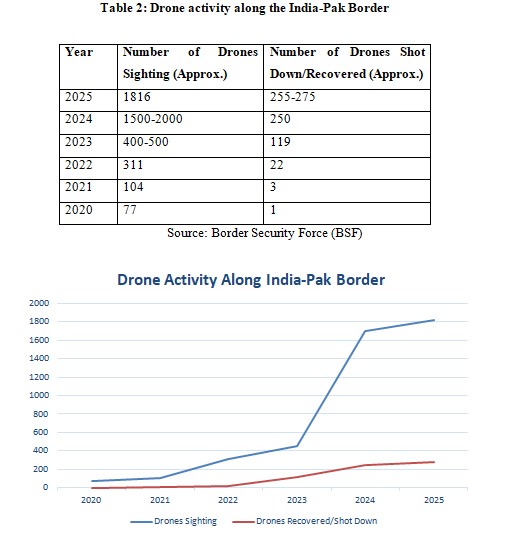
The Border Security Force (BSF), as evident from the figures in Table 2, has neutralised hundreds of drones over the past six years. The exponential rise in drone activity across the border highlights the rapid proliferation of drones, as well as their acquisition and integration by both state and non-state actors into their offensive strategies. According to BSF officials, the size of drones and consignments has decreased, while the number of cheaper drones operating across the India–Pakistan border has increased8. While Lahore in Pakistan has been the epicentre of the origin of these drones, Punjab in India has been the recipient of most of them. Bordering districts such as Amritsar, Tarn Taran, Ferozepur, and Gurdaspur have emerged as hotspots for drone-driven drug drops9. In Rajasthan, the Ganganagar district is the major hotspot of drone-driven drug activities
Considering the increasing cases of smuggling through drones, the Punjab government launched the ‘Baaj Akh’ Anti-Drone System to curb cross-border smuggling10. BSF has launched the Central Drone Forensic Lab (CDFL) for analysing, tracing, and deconstructing drones coming from Pakistan. This will help the forces to understand the route, strength and limitations of the UAVs flying across the border. BSF has also opened a Drone Warfare School at its training institute in Tekanpur, Madhya Pradesh, to equip the security personnel with the skills to operate and fly the drones for various defensive and offensive purposes11. These developments indicate that, with increasing sophistication in drone technology, smugglers have also brought changes to their strategies.
They have minimised the size of drones to evade detection and have diversified, if not diverted, routes from Punjab to Rajasthan to overcome counter-drone systems. Furthermore, the waterlogged regions and rugged terrain along the border make monitoring cumbersome, which smugglers appear to be exploiting to their advantage. The preparedness of the state government and the BSF indicates a growing realisation of the gravity of the security threat these activities could pose.
Operation Sindoor and Drones
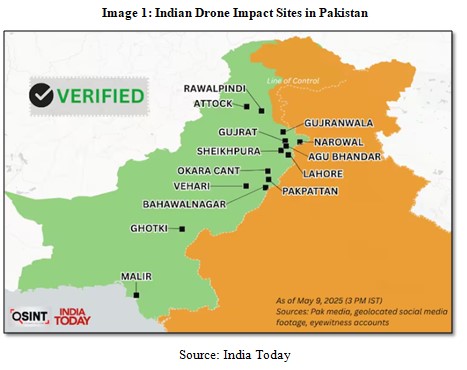
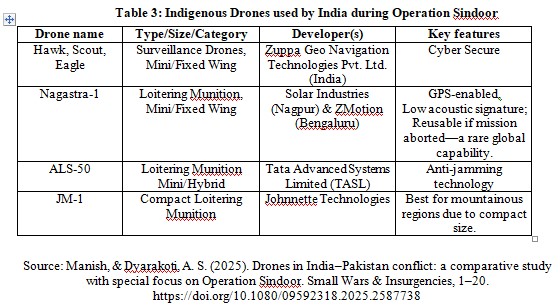
Operation Sindoor, launched by India on 7th May 2025 against Pakistan in response to the dastardly terrorist attack in the Pahalgam district of the Indian state of Jammu and Kashmir, marked an inflexion point in the deployment of drones between India and Pakistan. India launched missile strikes on 9 terrorist bases in Pakistan and Pakistan-occupied Kashmir (PoK), drawing a new strategic red line12. Drones played a primary role in surveillance and a major supporting role in carrying out strikes. It was for the first time that both India and Pakistan used drones against each other for both surveillance and precision strikes in a direct conflict. Both countries used a mix of indigenous and foreign unmanned systems to gain an advantage over one another. India used Israeli systems such as Searcher and Heron, along with indigenous systems, as shown in Table 3. The usage of the Harop drone, a loitering munition, to target Pakistan’s terrorist sites and bases was widely reported. According to an analysis by India Today, Indian drones either hit, crashed or were shot down in at least 13 places, as shown in image 1, in Punjab and Sindh provinces13
The special briefings issued by India’s Ministry of External Affairs (MEA) on 8, 9, and 10 May 2025 confirmed the employment of UAVs and UCAVs by Pakistan, alongside other long-range weapon systems, including loitering munitions and fighter aircraft. According to the MEA, these systems were used to target both civilian areas and military infrastructure in India14. Pakistan deployed both indigenous UAVs as well as Turkish- and Chinese-made foreign unmanned systems. These likely included Bayraktar TB2s, YIHA and Songar drones of Turkey; rainbow and Wing Loong series drones from China and indigenous platforms such as Burraq and Shahper. As per Indian officials, on May 08-09, Pakistan sent around 300-400 drones to 36 locations.
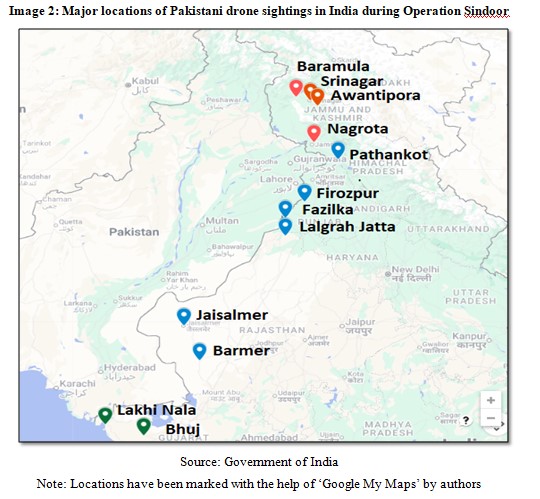
On May 09-10, Pakistani drones were sighted at 26 locations along the International Border and LoC with Pakistan in Jammu & Kashmir, Punjab, Rajasthan and Gujarat, as shown in image 215. These were neutralised by India’s multi-layered air defence system such as S-400 and indigenous Akashteer system. Loitering munitions were used to find and destroy high-value targets, including radar and missile systems of Pakistan16.
The deployment of drones in Operation Sindoor during this conflict demonstrated that drones are not only the future but also the present of warfare. Although the scale of their deployment and engagement was not at par with the Russia-Ukraine war, it brought to the fore the necessity of having a strong drone capability and ecosystem. It provided both countries about each other’s drone capability suitable for an active battlefield environment. This is evident from various reports regarding the potential acquisition of more drones in the times to come. Post Operation Sindoor, the Indian Army has equipped 380 infantry battalions with drone platoons comprising ISR, kamikaze, and armed drones17. The Indian Army is also reported to be in the advanced stage of acquiring 850 indigenous kamikaze drones worth 2000 crores18. This shall empower the infantry by strengthening their capability to see, sense, and strike beyond the line of sight.
The proliferation of drones and their increasing usage by both states and non-state actors also have implications for the regional stability and escalation dynamics. Drones are known as easy-to-deploy instruments, causing no collateral damage and risk to the pilot, unlike a conventional manned aircraft. They lower the political and operational threshold, but at the same time, they also create uncertainty and ambiguity, blurring the lines between “surveillance” and “strike”19. Therefore, their deployment also runs the risk of increasing escalation dynamics in the region, where mistrust is deeply entrenched, and clear communication is hampered due to historical rivalry and acrimony20
Conclusion
The evolution of drones in the India–Pakistan rivalry marks a significant shift over the past few years. From their initial use for surveillance purposes, drones are now also being used for the smuggling of drugs and ammunition, as well as for carrying out precision strikes across the border. Operation Sindoor witnessed both India and Pakistan employing their drone and counter-drone capabilities. The conflict brought to the fore the significance of drones in conflicts between India and Pakistan. Given India’s continued dependence on imports for critical drone components, it is important to develop and strengthen domestic supply chain capabilities to ensure that India becomes self-reliant in drone manufacturing and free from any security vulnerabilities arising from the use of imported systems. As drones emerge as an important weapon on the battlefield, both India and Pakistan are likely to witness a greater arms race in drones in the future
References:
1. China’s dominance overshadows India’s drone ambitions despite breakthroughs. National Herald.2025, May 28. https://www.nationalheraldindia.com/national/chinas-dominance-casts-shadow-over-indias-drone-ambitions-despite-battlefield-breakthroughs
2. Ibid
3. Budhiraja, A. (2025, June 21). India’s defence drones: Powered by high-end manufacturing tools | Hindustan Times. Hindustan Times. https://www.hindustantimes.com/ht-insight/economy/indias-defence-drones-powered-by-high-end-manufacturing-tools-101750491136397.html
4. “The Drone War in Pakistan”, New America, https://www.newamerica.org/future
5. Basit, A. (2025, August 07). Growing Use of Drones by Militant Groups in Pakistan’s Khyber Pakhtunkhwa” Diplomat, https://thediplomat.com/2025/08/growing-use-of-drones-by-militant-groups-in-pakistans-khyber-pakhtunkhwa
6. Welle, D. (2015, September 7). Pakistan claims first-ever deadly drone strike. dw.com. https://www.dw.com/en/pakistan-claims-first-ever-deadly-drone-strike/a-18697431#:~:text=A%20missile%20fired%20from%20a,its%20indigenously%20developed%20armed%20drone
7. Drone attack at Jammu air base: 2 suspects detained, IAF chief monitoring situation | What has happened so far. India Today. 2021, June 27. https://www.indiatoday.in/india/story/drone-attack-jammu-air-base-top-points-1819969-2021-06-27
8. Chhina, M. a. S. (2025, December 3). BSF identifies ‘hot spots’ of Pak drone activity in Punjab: ADG. The Indian Express. https://indianexpress.com/article/cities/chandigarh/bsf-identifies-hot-spots-of-pak-drone-activity-in-punjab-adg-10399535/
9. Pandey, D. K. (2025, September 16). India-Pakistan border sees a sharp rise in drone-driven drug smuggling cases. The Hindu. https://www.thehindu.com/news/national/drone-driven-drug-smuggling-cases-along-india-pakistan-border-skyrocket-from-three-in-2021-to-179-in-2024-says-ncb-report/article70057513.ece
10. Punjab launches ‘Baaj AKH’ Anti-Drone System to Curb Cross-Border Drug Smuggling. Akashvani News, https://www.newsonair.gov.in/punjab-launches-baaj-akh-anti-drone-system-to-curb-cross-border-drug-smuggling/
11. Tiwary, D. (2025, September 22). In post-Sindoor push, 1st batch of BSF ‘drone commandos’ soon. The Indian Express. https://indianexpress.com/article/india/in-post-sindoor-push-1st-batch-of-bsf-drone-commandos-soon-10263623
12. Press Information Bureau (May 14, 2025). Operation SINDOOR: India’s Strategic Clarity and Calculated Force. https://www.pib.gov.in/Pressreleaseshare.aspx?PRID=2128748®=3&lang=2#:~:text=Nine%20Terror%20Camps%20Eliminated%3A%20India,terrorists%20were%20killed%20in%20action
13. Tiwari, S., Saha, B., Sharma, A. (2025, May 9). Verified locations of Indian drone impact sites in Pakistan. India Today. https://www.indiatoday.in/world/story/indian-drones-strike-pakistan-locations-verified-sites-2722245-2025-05-09
14. Ministry of External Affairs. (May 10, 2025). Transcript of Special briefing on OPERATION SINDOOR (May 10, 2025). https://www.mea.gov.in/media-briefings.htm?dtl/39486/Transcript+of+Special+briefing+on+OPERATION+SINDOOR+May+10+2025
15. Ministry of Defence (May 10, 2025). Drones have been sighted at 26 locations along the International Border and LoC with Pakistan. https://x.com/SpokespersonMoD/status/1920914711601967166?lang=en
16. Press Information Bureau. (May 14, 2025). Operation SINDOOR: The Rise of Aatmanirbhar Innovation in National Security. https://www.pib.gov.in/PressReleasePage.aspx?PRID=2128746®=3&lang=2
17. The Economic Times. (2025, October 22). Army equips 380 infantry battalions with “Ashney” drone platoons. The Economic Times. https://economictimes.indiatimes.com/news/defence/army-equips-380-infantry-battalions-with-ashney-drone-platoons/articleshow/124744881.cms?from=mdr
18. Hindustan Times. (2025, December 19). Indian Army to buy 850 Kamikaze drones worth ₹2,000 crore: Report | India News. Hindustan Times. https://www.hindustantimes.com/india-news/indian-army-to-buy-850-kamikaze-drones-worth-rs-2-000-crore-report-101766159474706.html#google_vignette
19. The First Drone War: India-Pakistan Conflict Enters a New Era of Unmanned Warfare. Imageusa.com. May 09, 2025, https://imageusa.com/the-first-drone-war-india-pakistan-conflict-enters-a-new-era-of-unmanned-warfare/#:~:text=Precision%20Strike%20Tools:%20Capable%20of,defenses%20without%20risking%20manned%20aircraft.%E2%80%9D
20. Manish, & Dyarakoti, A. S. (2025). Drones in India–Pakistan conflict: a comparative study with special focus on Operation Sindoor. Small Wars & Insurgencies, 1–20. https://doi.org/10.1080/09592318.2025.2587738
